
Housing scarcity is a systems problem
Shared ahead of publication
Technological stagnation
Housing supply is not a financial problem, but an engineering problem disguised as a financial one.
The relationship between engineering and economics, however, is interdependent because technological improvements act to bring prices down.
For this reason, technological innovations, especially paired with modern manufacturing, can be deflationary, giving consumers "more bang for their buck." One of the most striking modern examples is the price of solar modules for solar panels that have dropped some 99.6% since 1976, providing consumers more energy per unit cost of the system.
These deflationary forces are seen across numerous industries such as farming, medicine, and data storage and processing. Overall, these technological advancements have raised living standards for an increasing number of people worldwide.
However, one industry that has evaded such improvement is housing, where costs of construction have inflated over time. This trend is highlighted in an August 2024 McKinsey report showing that labour productivity—measured in terms of real gross value added per hour worked—compounded just 0.4% from 2000-2022 compared to 3.0% in the manufacturing sector and 2.0% for the overall economy.
Furthermore, a recent Statistics Canada report showed that labour productivity, in the residential construction industry, decreased by a cumulative 37.3% between 2001-2023. This contrasted with an overall 12.5% increase in productivity in the broader business sector.
There is striking inefficiency on the governmental side as well, with increasing approval costs and bureaucracy. The average time it takes for a multi-residential housing project to get approved in the Greater Toronto Area is 21 months—this is the time between the start of a development application and when construction can start.
I have personally experienced timelines upwards of 4 years for a site plan approval.
Fees have risen precipitously as well. As one example, development Charges in Toronto—which are municipal fees levied against developers per unit for public infrastructure—were $8,021 in 2009 and in 2026 this same unit cost the developer $48,299. On a 150-unit apartment, this fee alone increases the cost of the project by $7,244,850, materially increasing the minimum rent required to support the building's construction.
It's commonly noted in Toronto that the only thing taxed more than housing is cigarettes.
The pairing of technological stagnation with compounding bureaucracy, fees and regulation has produced an affordability crisis for current and future generations.
The high cost of housing
I'm a millennial born and raised in Toronto. And the price difference between my first home and that of my parents' first home is striking. In 1980 the average home in the Greater Toronto Area cost roughly 3x income whereas in 2020 that multiple grew to roughly 10x income. This is the difference between a $30k annual household income in 1980 supporting the purchase of a $90,000 home and a $100k annual household income in 2020 supporting a $1 million home.
Comedian Alex Edelman calls out these trends by satirising a boomer who expresses "my house is worth two million dollars, but when I bought it in 1981, I paid 11 raspberries for it…". Of course, this is hyperbole in service of humour, but as is the case with many good comedians, the joke captures something true.
Housing scarcity and unaffordability present one of our greatest—and unsolved—societal challenges: to invent the development system that can best convert land, capital, raw materials, and labour into housing.
This is a difficult problem that reflects, as Nicholas Negroponte observed, the difference between scaling bits and scaling atoms. Whereas bits—or digital information—are inherently scalable, e.g., software distribution, transformation of matter into housing units is subject to physical constraints.
Scaling housing also differs from scaling the production of other manufactured products. For instance, cars and computers are complicated but have the advantage of being produced entirely in closed-loop conditions and are all identical. Housing units need to be produced across varied geographies and respect site-specific physical and legislative conditions. This makes achieving housing abundance a uniquely challenging ambition.
Housing as a store of value
It's not just the technicality of the problem that has made innovation difficult but also the lack of market incentive. Home prices have experienced significant inflation over the decades, at least in part because housing acts as a store of value. This differs from most manufactured products that get cheaper over time in inflation and performance-adjusted terms.
In fact, residential real estate is the largest asset class globally, valued at $287 trillion. For perspective, global equities total approximately $128 trillion. For this reason, legislation often acts to support home price growth. Interest rate controls, longer mortgage amortization schedules, and loan insurance products are all interventions that help people afford increasingly higher home prices, especially in the context of slower wage growth.
In Canada, another such intervention is government mandated Affordable Units, often linked to federal or municipal housing supply programs, like the $13 billion Build Canada Homes initiative and many government-backed commercial loan products. These rent-controlled units are meant to provide more affordable housing options.
This allows the government to have their cake and eat it too by supporting asset appreciation while simultaneously instituting price controls, on a subset of units, in the interest of perceived affordability.
This type of demand-side intervention functions to help people keep up with home price growth. Because these programs support appreciating prices, they override the incentive for developers to innovate cheaper delivery models to serve renters or buyers.
These interventions reflect the common misunderstanding that price can be independently controlled from its underlying factors, e.g., land prices, construction costs, government levies, interest rates etc. This is a misspecification error. Price is a dependent variable, or output of the underlying economics; it cannot be sustainably affected without changes to the underlying structure that influences price.
The state of our current development system
The myopic focus on price engineering over process engineering is reflected in how we underwrite deals. The most common phrase amongst developers in response to why housing units don't get built is "that projects don't pencil…" Developers engage in a perpetual search for land deals that pencil, without revisiting the underlying assumptions in their development model that are upstream of project viability.
The deeper systemic issue is that this underwriting is all done on proformas that reflect a housing system that is no longer performing. Systems theorist Stafford Beer notes "the purpose of a system is what it does." The implication for our housing system is that our delivery model is broken because the output is scarce and too expensive.
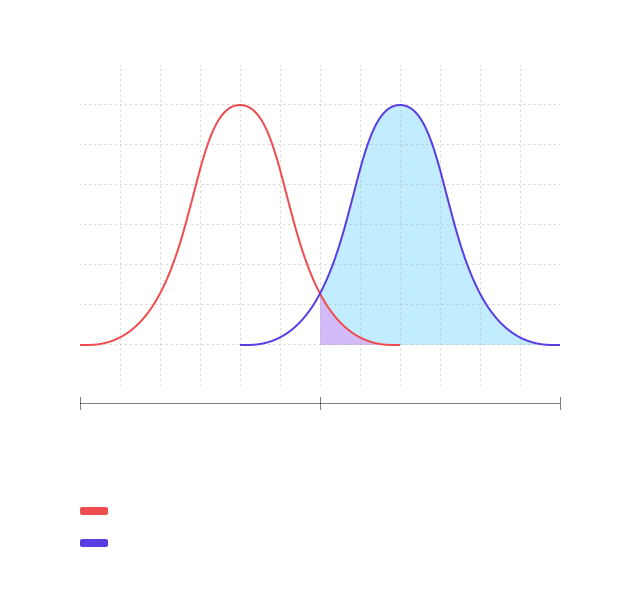
The figure below seeks to illustrate this point. The figure shows two hypothetical frequency distributions with the red distribution representing the current model—where most projects don't pencil—and the blue distribution representing a new model where most projects pencil.
 Relative Frequency
Low Project Viability
Threshold for Project Viability
High Project Viability
Current model: null hypothesis = not viable
New model: null hypothesis = viable
Relative Frequency
Low Project Viability
Threshold for Project Viability
High Project Viability
Current model: null hypothesis = not viable
New model: null hypothesis = viable
Specifically, these distributions show the relative frequency of economically viable projects, with project viability increasing from left to right i.e., does the project pencil?
In the current system, the null hypothesis when underwriting most deals should be that projects don't pencil, given the underlying models reflect a failing system (red distribution). Most projects won't work and only a small minority in select circumstances will (threshold for project viability). Efforts to promote viability—policy or incremental technological improvement—operate within this failing framework to force viability.
In contrast, a successful housing system would generate the opposite scenario. In this possible future, housing could be built plentifully and reliably most of the time and only a small minority of projects would fail to pencil (blue distribution).
Venture capitalist Peter Thiel refers to transformational innovation (i.e., innovating a system that generates the blue distribution) as moving from 0 → 1, which is far more impactful than from moving from 1→n. For instance, communication networks could only improve so far with faster horses, new postal systems, or steamships. These communication systems were inherently limited because of physical constraints. However, the phone and internet age removed physical constraints, ushering in an age of instant connectivity that was effectively free.
In the housing industry, the transition from 0→1 would be captured by the shift from project-based development models to a system-based housing supply solution. This shift will replace traditional models that inflate over time—based on cost-plus economics—that rely primarily on onsite construction and are funded through risk-averse capital that optimizes for individual project economics over long-term economical housing output.
Understanding housing supply as the technical problem it is requires a solution rooted in science, technology, and engineering, where the output is abundance and affordability. The challenge is to design the system that yields the result society needs.
Qualities for a new housing delivery system
Housing abundance requires a system that can operate and grow at scale. Currently, development companies' growth is linear and largely local in its operations. Companies hire more people and do more projects. But their output is always linearly proportionate to the input.
In contrast, a scalable solution needs to be structurally capable of scale.
I believe the best format for scale is a developer-platform company that engages in actual building projects—driving innovation and system-building—and provides the infrastructure and the development framework to support 3rd party housing delivery.
Platform distribution allows the company to scale rapidly and effectively with demand in a way that vertically integrated real estate firms cannot. In this way, the company isn't reliant on self-developed projects for growth. Real scale comes from partnerships and wider adoption.
The role of prefab
I believe that manufacturing-based, prefabricated building products will form the critical element of the solution. Critics of prefab construction will correctly point out that prefab has been around for 100 years and hasn't materially improved construction efficiencies.
However, I believe this is largely because such systems are treated as local substitutes for onsite analogues, leading to incremental improvements to the status quo, at best.
Developers commonly remark that "prefab may be faster, but not cheaper," capturing the reductionist understanding of prefab today. In fact, what matters is not prefab price but project price. When pursuing system-level optimizations, it's common to observe sub-optimality at the local level, i.e., high prices for individual building components, in service of overall price reductions.
Prefab has the potential to be transformative because it can be productized for manufacturing through manufacturing-native software formats like CATIA. This moves prefab from the architectural domain into the manufacturing ecosystem, like mass produced products like cars and computers.
Manufacturing processes have the capacity to reduce costs of production to make products cheaper, reflecting Wright's Law, showing that each doubling of cumulative output reduces unit price by a fixed percentage.
In theory, each price drop would also increase demand which in turn accelerates production leading to faster doubling times—and the corresponding price drops—creating a positive feedback loop.
Capturing these production and price dynamics will be critical to success.
This technological deflation is one of the key factors enabling abundance. In contrast, project-based models that don't employ the manufacturing sector at scale have no potential for output-based price reductions, an important reason why the cost of housing delivery hasn't gone down.
Unfortunately, our current implementation of prefab doesn't deflate project costs over time. Typically, developers have no control over the production, pricing is opaque, and scale is limited because expansion to new markets is constrained by the location of the prefab supplier. And factories are capital intensive to replicate.
Until these limitations are overcome, each prefab product will remain a product option on each project, rather than a fundamental element of a dominant design and delivery infrastructure.
A new business model: from project-based to system-based
Local, project-based, innovations have limited influence on the overall system. Transformational change will not come from innovative products and services but from a complete redesign of how we do housing, to afford scale.
I propose a model that leverages prefab products, as the fundamental enabler of better housing delivery, but doesn't rely on commercially available components or produce them in self-owned factories.
Commercially available prefab products are subject to production bottlenecks, non-exclusive use, 3rd party risk, competition, opaqueness in pricing and markups on production, and is limited to regions where these producers are located, to reduce shipping costs and logistic complexities. On the other hand, self-owned factories don't scale well without substantial capital investment and concomitant market demand.
The alternative model is to vertically integrate only that which offers value to the development platform business; ownership/control of prefab designs, raw material procurement for purchasing power, site specific analyses and instant costing, standardized contracting structures for offsite and onsite construction integration, product delivery logistics, and the digital infrastructure to unify this all.
As for manufacturing capacity, I believe the most scalable structure involves contracting with existing 3rd party manufacturers to form a network of decentralized production. In this way, the development platform business owns the network to enable scale across expansive geographies—representing the greatest value source for the business—while mitigating the capital requirements necessary for vertically integrated growth.
This structure eliminates the limitations of purchasing commercially available products or building self-owned factories because the developer owns the designs and production system while leveraging existing capital infrastructure as a production service, i.e., the capacity to produce the product provides value not the ownership of the capital infrastructure to do.
Scale is achieved because new manufacturers can be recruited with minimal investment as demand is generated. Decentralizing production takes a prefab product and embeds it into a housing delivery system that is centrally controlled but executed in a decentralized manner.
Decoupling land-entitlement from modular assembly will further enable scale. The developer can partner with local developers who will undertake the land entitlement and traditional construction. The modular developer will come in late in the development schedule—and at a time with reduced risk—to assemble and complete the project.
This model will massively accelerate timelines as there's a reasonable division of labour and the modular developer doesn't require detailed knowledge of each site.
I believe this platform format will have greater long-term potential for scale and price deflation. Each project will be judged on its capacity to iteratively improve and scale the system. The overall result is a path to housing abundance that doesn't exist today.
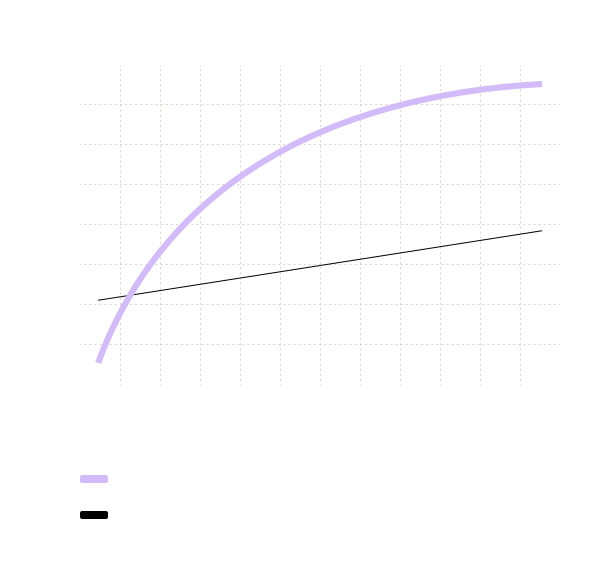
The figure below shows the performance goals of housing delivery over time with the black curve representing the current, project-based, model (non-iterative) and the lavender representing a new model (systems-based, feedback-driven, manufacturing performance improvements). A key detail shown on this figure is the poorer performance of the new model to start. This is often where competing systems begin; worse compared to the status quo but conducive to rapid improvements if structurally better.
 Performance (scale and price deflation)
Time/Cumulative Output
Prefab-enabled Development Models
Current Development Models
Performance (scale and price deflation)
Time/Cumulative Output
Prefab-enabled Development Models
Current Development Models
The Wright brothers' first flight was in 1903 when they travelled 120 feet, which was far worse (and more dangerous) than any other form of transportation at the time. And within just 66 years, the United States put a man on the moon and air travel was ubiquitous. What's important is the long-term potential of the model not its debut performance.
The big difference with this structure is that value shifts from being derived from real estate generated returns to platform value. Value is created from network capacity to deliver housing rather than the housing itself, which also acts to shift the source of value away from real estate asset appreciation towards actual housing delivery. The latter is the purpose of a system designed to generate abundance.
Without this fundamental shift—from project-based models and incremental improvements to transformational change in our underlying design and delivery architecture—we default to local improvements to a broken system
The mission of housing abundance
One of the reasons why housing abundance hasn't been achieved is because nobody has built a company for this purpose.
Typical development firms have websites with statements like "building vibrant, complete, and inclusive communities" or "designing places people want to live, work, and play," or "focus on craftsmanship, aesthetics, and lifestyle." None of these statements inspire nor provide any overarching objective.
For instance, there's no housing equivalent to Google's mission "to organize the world's information and make it universally accessible and useful" or SpaceX's mission "to make humanity multi-planetary" or Anthropic's mission "to ensure that transformative AI has a positive impact on humanity".
The next generation development firm will emerge as a solver of scarcity and unaffordability and will do so because they're designed to.
Funding
Funding these new structures for housing delivery will be challenging for traditional real estate investors like institutions and family offices. I've personally been in several meetings with large real estate firms describing some of these principles and the common response I get is "sounds neat, send me a proforma when you have a deal we can underwrite."
The investing culture for these groups follows the current project-based models where each project needs to economically perform as a standalone investment. This strategy may buffer risk of capital loss in the short term but won't promote the experimentation required to properly innovate the field.
The current funding models focus on project economics—not system economics—because most of the value is in the real estate. That is, the enterprise value of a real estate company approximates the value of its portfolio; in other words, there is no significant source of value outside its tangible balance sheet assets.
However, a platform business that successfully delivers housing abundance will have created a whole other value layer that incorporates IP, network control, delivery protocols, and the ability to scale by way of traditional developers.
Venture Capital is more aligned with this model and structured to pursue transformational innovation, at higher risk. I believe that a division of labour will emerge where Venture Capital will fund the innovative new housing startups and more traditional project funding will still support development projects. Project investors will get their returns on project delivery and the Venture Capital firms will profit on the solutions themselves.
Conclusion
A future of housing abundance and affordability is possible if we engineer it to be.
One of our best strengths as human beings is the capacity to manipulate our environment to solve big problems like this. The problem with our current system can be solved with a systems-level, engineering-first approach.
The solution won't be in incremental technological improvements but in a transformative new development model that's structurally capable of ushering in an age of housing abundance.